The Impact of Digital Banking Adoption, Risk Management and Balanced Scorecard on Indonesian Banking Performance – A Conceptual Paper
DOI:
https://doi.org/10.22452/AJAP.vol%2016.5Keywords:
Bank Performance, Digital Banking Adoption, Risk Management, Balanced Scorecard ImplementationAbstract
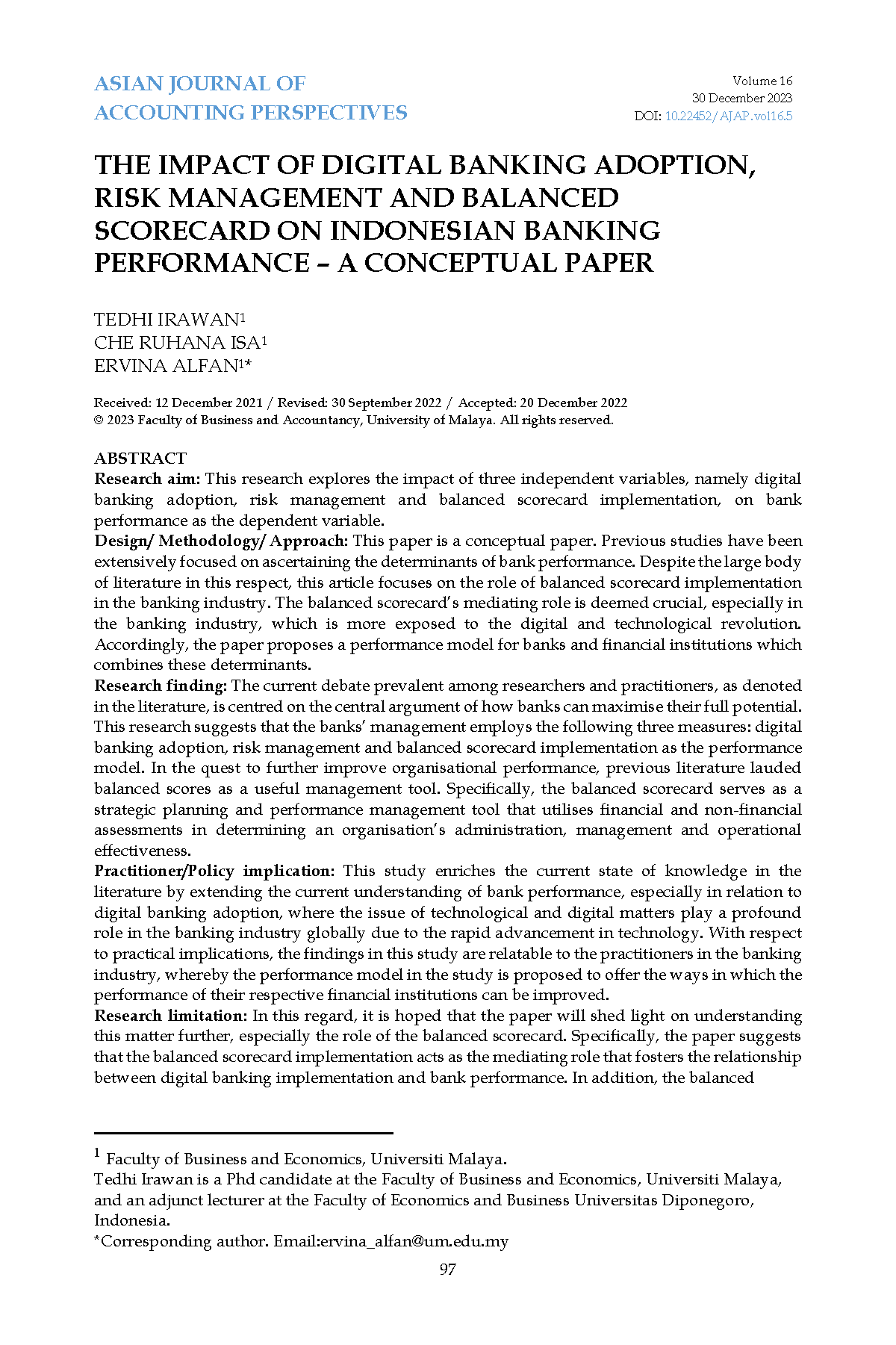
Research aim: This research explores the impact of three independent variables, namely digital banking adoption, risk management and balanced scorecard implementation, on bank performance as the dependent variable.
Design/ Methodology/ Approach: This paper is a conceptual paper. Previous studies have been extensively focused on ascertaining the determinants of bank performance. Despite the large body of literature in this respect, this article focuses on the role of balanced scorecard implementation in the banking industry. The balanced scorecard’s mediating role is deemed crucial, especially in the banking industry, which is more exposed to the digital and technological revolution. Accordingly, the paper proposes a performance model for banks and financial institutions which combines these determinants.
Research finding: The current debate prevalent among researchers and practitioners, as denoted in the literature, is centred on the central argument of how banks can maximise their full potential. This research suggests that the banks’ management employs the following three measures: digital banking adoption, risk management and balanced scorecard implementation as the performance model. In the quest to further improve organisational performance, previous literature lauded balanced scores as a useful management tool. Specifically, the balanced scorecard serves as a strategic planning and performance management tool that utilises financial and non-financial assessments in determining an organisation’s administration, management and operational effectiveness.
Practitioner/Policy implication: This study enriches the current state of knowledge in the literature by extending the current understanding of bank performance, especially in relation to digital banking adoption, where the issue of technological and digital matters play a profound role in the banking industry globally due to the rapid advancement in technology. With respect to practical implications, the findings in this study are relatable to the practitioners in the banking industry, whereby the performance model in the study is proposed to offer the ways in which the performance of their respective financial institutions can be improved.
Research limitation: In this regard, it is hoped that the paper will shed light on understanding this matter further, especially the role of the balanced scorecard. Specifically, the paper suggests that the balanced scorecard implementation acts as the mediating role that fosters the relationship between digital banking implementation and bank performance. In addition, the balanced scorecard implementation also acts as the factor that mediates the relationship between risk management and bank performance.
Downloads
Published
Issue
Section
License
LicenseLicense
The Asian Journal of Accounting Perspectives (AJAP) articles are published under a licence equivalent to the Creative Commons Attribution-NonCommercial-NoDerivs License (CC BY-NC-ND). The licence allows users to copy, distribute, and transmit an article as long as the author is attributed. The article is not used for commercial purposes. The work is not modified or adapted in any way.
Copyright
Authors are required to sign the Exclusive License to Publish agreement upon publication in the AJAP. The agreement grants the Publisher (Faculty of Business and Accountancy, Universiti Malaya) to publish and disseminate the articles.
Open Access
Articles published in the AJAP are digital, online, free of charge, and free of most copyright and licensing restrictions.
Article Processing Charge
Articles publish in AJAP is free submission, production and publication charges. However, all accepted articles are required for language editing. The AJAP officially appointed and outsourced proofreader will conduct this process, and the authors will cover the cost. AJAP does not profit from this process and transaction.