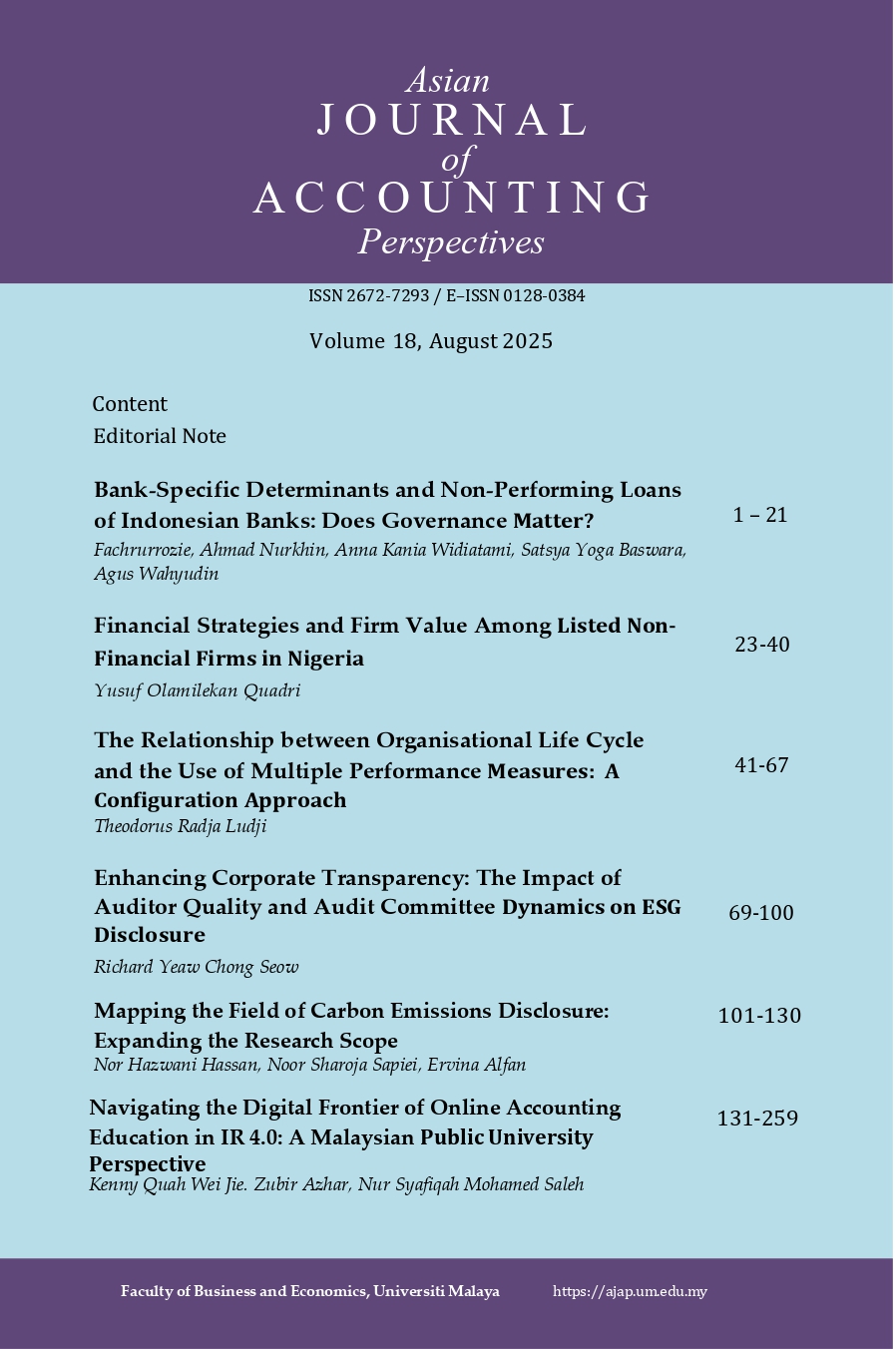
Enhancing Corporate Transparency: The Impact of Auditor Quality and Audit Committee Dynamics on ESG Disclosure
DOI:
https://doi.org/10.22452/ajba.vol18no1.4Keywords:
ESG disclosure, Audit committee, Auditor quality, Agency theory, Stakeholder theoryAbstract
Research aim: This study examines the relationship between audit committee (AC)
dynamics, such as size, gender diversity, and independence, auditor quality, and ESG
disclosure practices.
Design/ Methodology/ Approach: Using a weighted least squared regression method,
this study analyses 315 firm-year observations from 63 Malaysian public-listed companies
between 2018 and 2022.
Research finding: The results indicate that AC independence and gender diversity
significantly enhance ESG, social, and governance disclosures, while AC size negatively
impacts social and governance disclosures. Auditor quality showed limited influence, with
a negative effect on governance disclosure.
Theoretical contribution/Originality: This study contributes to agency and stakeholder
theories by emphasising AC attributes’ roles in mitigating information asymmetry and
addressing stakeholder interests. It challenges existing assumptions about auditor quality,
suggesting the need for ESG-specific audit frameworks, particularly in emerging markets.
Practitioner/Policy implication: For policymakers, the findings highlight the need to
strengthen governance frameworks by promoting AC independence and diversity.
Practitioners, especially audit firms, should integrate ESG expertise to support companies
effectively. Regulators may consider revising corporate governance codes to encourage
balanced ESG disclosures across all dimensions.
Research limitation: The study focuses solely on 63 Malaysian public-listed companies,
using data between 2018 and 2022.
Downloads
Published
Versions
- 2025-11-20 (2)
- 2025-09-24 (1)
Issue
Section
License
LicenseLicense
The Asian Journal of Accounting Perspectives (AJAP) articles are published under a licence equivalent to the Creative Commons Attribution-NonCommercial-NoDerivs License (CC BY-NC-ND). The licence allows users to copy, distribute, and transmit an article as long as the author is attributed. The article is not used for commercial purposes. The work is not modified or adapted in any way.
Copyright
Authors are required to sign the Exclusive License to Publish agreement upon publication in the AJAP. The agreement grants the Publisher (Faculty of Business and Accountancy, Universiti Malaya) to publish and disseminate the articles.
Open Access
Articles published in the AJAP are digital, online, free of charge, and free of most copyright and licensing restrictions.
Article Processing Charge
Articles publish in AJAP is free submission, production and publication charges. However, all accepted articles are required for language editing. The AJAP officially appointed and outsourced proofreader will conduct this process, and the authors will cover the cost. AJAP does not profit from this process and transaction.