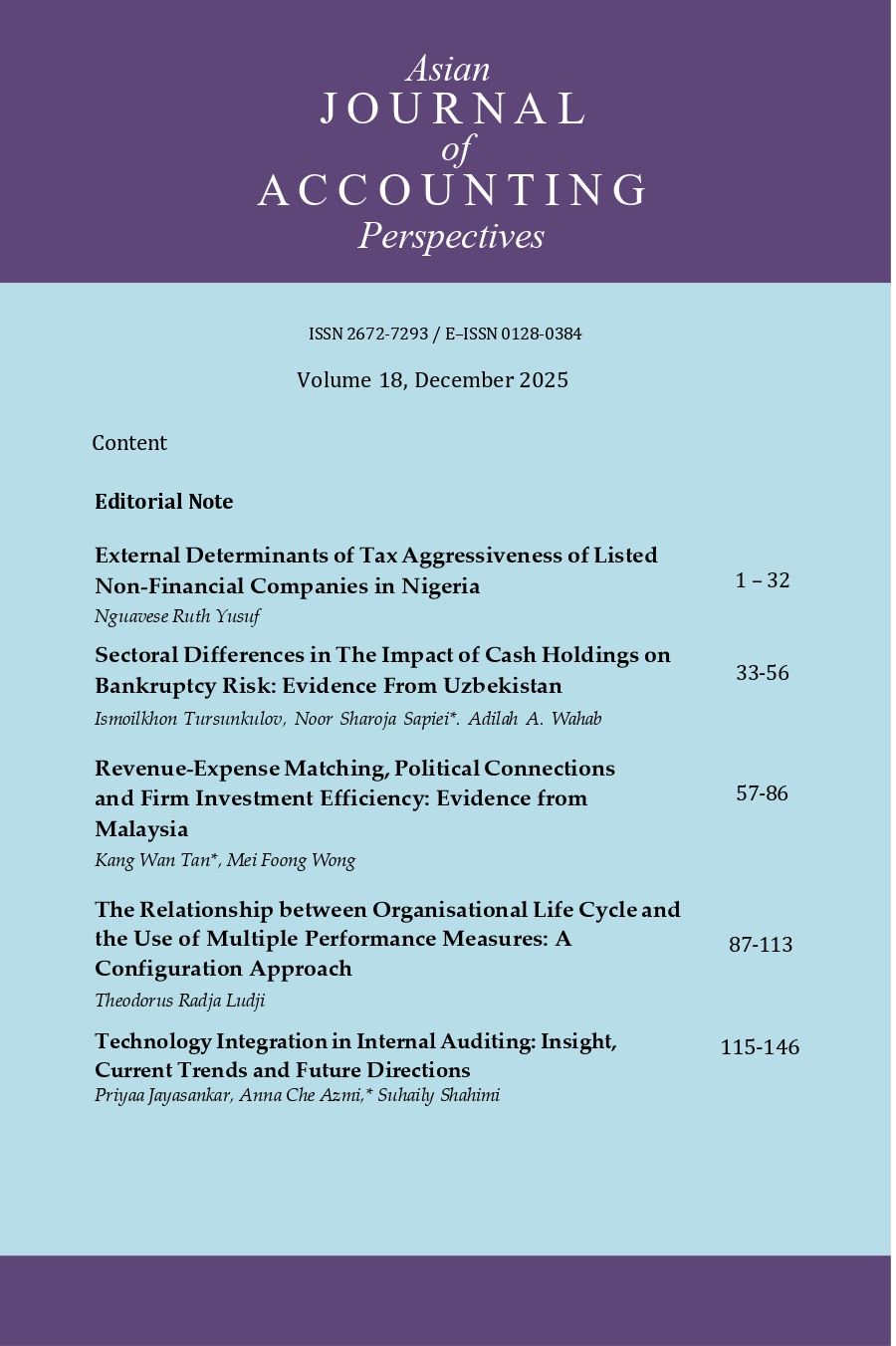
Revenue-Expense Matching, Political Connections and Firm Investment Efficiency: Evidence from Malaysia
DOI:
https://doi.org/10.22452/AJAP.vol18no2.3Keywords:
Revenue-expense Matching, Political Connections, Investment Efficiency, MalaysiaAbstract
Research aim: This study examines the interplay between revenue-expense matching,
political connections, and firm investment efficiency within the Malaysian context.
Design/ Methodology/ Approach: Drawing on the revenue-expense matching framework
proposed by Dichev and Tang (2008), we construct a measure of matching quality and
employ ordinary least squares (OLS) regression on a sample of 570 Malaysian publicly
listed firms over the period 2000-2017 to investigate two key issues: (1) the extent to which
matching quality influences investment efficiency, and (2) whether political connections
moderate this relationship.
Research finding: The empirical evidence indicates that stronger revenue-expense matching
is positively associated with improved investment efficiency. However, this beneficial
effect is significantly weakened in the presence of political ties. Further analyses suggest
that this moderating influence is particularly pronounced among government-linked
companies. Additionally, high-quality matching appears to reduce both overinvestment
and underinvestment, although these advantages are markedly less evident in politically
connected firms.
Practitioner/Policy implication: While previous research has explored the intersection of
financial reporting quality, political affiliations, and corporate investment, this study is
among the first to empirically link revenue-expense matching with investment efficiency
in the context of political embeddedness. The findings not only enhance understanding of
how accounting quality and institutional structures interact to shape investment decisions
in emerging markets, but also offer policy insights by highlighting the need for governance
mechanisms that curb political influence and foster more efficient capital allocation.
Research limitation: This study acknowledges limitations, including potential
measurement issues, limited generalizability beyond Malaysia, and endogeneity concerns
that future research could address using causal inference methods.
Downloads
Published
Issue
Section
License
LicenseLicense
The Asian Journal of Accounting Perspectives (AJAP) articles are published under a licence equivalent to the Creative Commons Attribution-NonCommercial-NoDerivs License (CC BY-NC-ND). The licence allows users to copy, distribute, and transmit an article as long as the author is attributed. The article is not used for commercial purposes. The work is not modified or adapted in any way.
Copyright
Authors are required to sign the Exclusive License to Publish agreement upon publication in the AJAP. The agreement grants the Publisher (Faculty of Business and Accountancy, Universiti Malaya) to publish and disseminate the articles.
Open Access
Articles published in the AJAP are digital, online, free of charge, and free of most copyright and licensing restrictions.
Article Processing Charge
Articles publish in AJAP is free submission, production and publication charges. However, all accepted articles are required for language editing. The AJAP officially appointed and outsourced proofreader will conduct this process, and the authors will cover the cost. AJAP does not profit from this process and transaction.