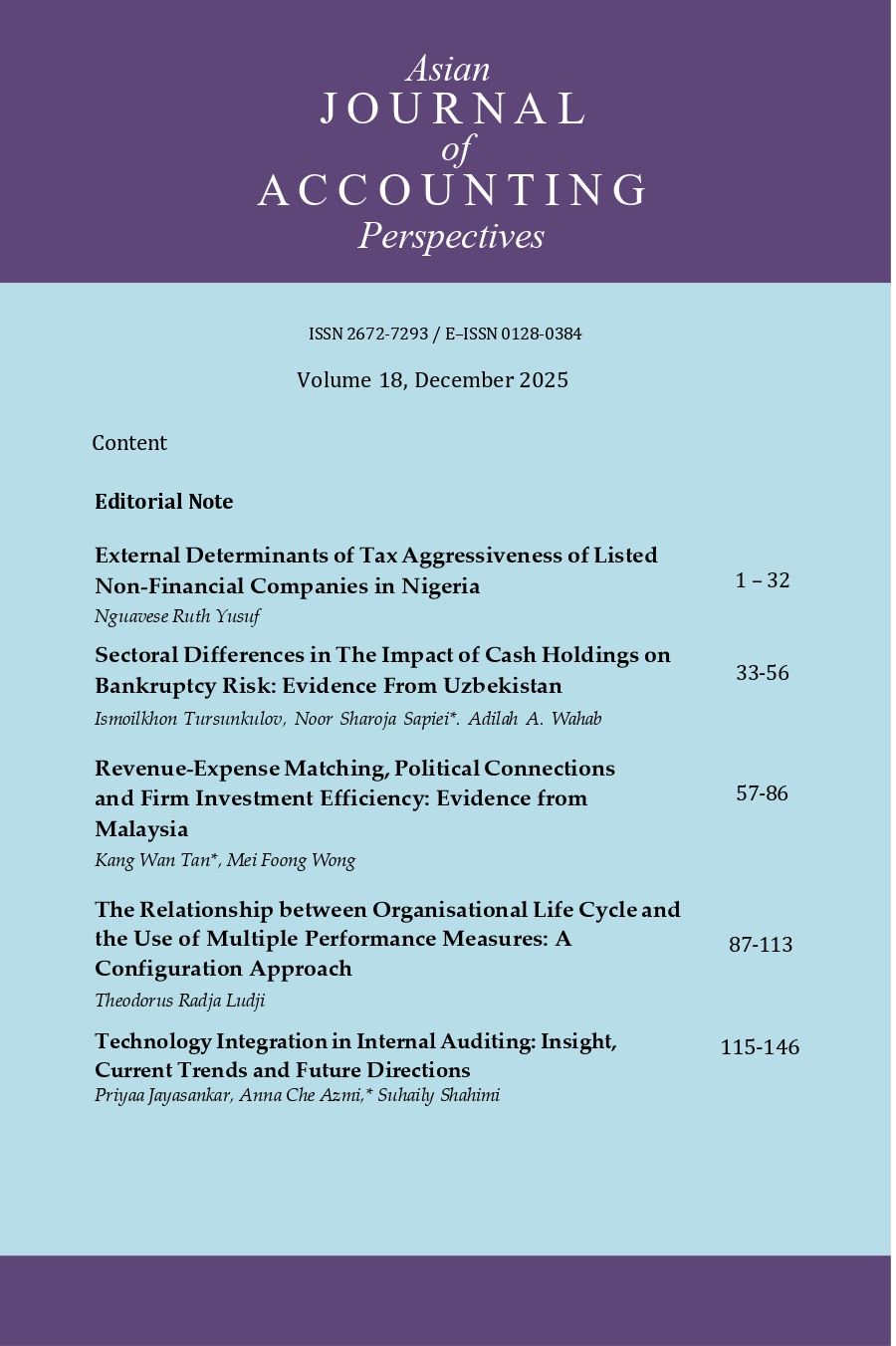
The Relationship between Organisational Life Cycle and the Use of Multiple Performance Measures: A Configuration Approach
DOI:
https://doi.org/10.22452/AJAP.vol18no2.4Keywords:
Organisational life cycle, Multiple performance measures, Configuration approach, Indonesian manufacturersAbstract
Research aim: This study investigates the relationship between organisational life cycle
(OLC) stages and the use of multiple performance measures (MPMs) across Indonesian
manufacturers. A configuration approach was used to categorise companies into different
OLC stages using Miller and Friesen’s (1984) typology.
Design/ Methodology/ Approach: A survey method was utilised, with the respondents
comprising 96 managers of Indonesian manufacturing companies. A cluster analysis with
hierarchical agglomeration and Ward’s minimum variance method was used to classify
companies into OLC stages. Analysis of variance (ANOVA) and pairwise comparison
analysis were used to examine the hypotheses.
Research finding: Significant differences in the usage of each and all MPM perspectives
was observable across OLC stages. A greater extent of the use of each and all MPM
perspectives was also demonstrated by companies in the growth stage, compared to
those in the maturity and birth OLC stages. A greater extent of the use of the customer
perspective and all MPM perspectives was documented by companies in the revival stage.
The learning and growth perspective was implemented to a marginally greater extent by
revival-stage companies than birth- and maturity-stage companies.
Theoretical contribution/Originality: This study contributes to contingency-based OLC
and performance measurement systems (PMSs) literature by documenting an association
between OLC stages and the use of MPM perspectives across Indonesian manufacturers.
Practitioner/Policy implication: Results of this study can enhance managers’ understanding
about the implication of OLC stages in influencing companies’ performance measurement
practices. This allows managers to make strategic decisions that are consistent with the
objectives and priorities of their company’s performance measures and respective OLC
stage.
Research limitation: The present study is related to the classification of companies into
OLC stages. Future studies can use different OLC classification approaches and/or different
typologies. This study is also limited to companies from the manufacturing sector and the
number of respondents, which may limit generalisation.
Downloads
Published
Issue
Section
License
LicenseLicense
The Asian Journal of Accounting Perspectives (AJAP) articles are published under a licence equivalent to the Creative Commons Attribution-NonCommercial-NoDerivs License (CC BY-NC-ND). The licence allows users to copy, distribute, and transmit an article as long as the author is attributed. The article is not used for commercial purposes. The work is not modified or adapted in any way.
Copyright
Authors are required to sign the Exclusive License to Publish agreement upon publication in the AJAP. The agreement grants the Publisher (Faculty of Business and Accountancy, Universiti Malaya) to publish and disseminate the articles.
Open Access
Articles published in the AJAP are digital, online, free of charge, and free of most copyright and licensing restrictions.
Article Processing Charge
Articles publish in AJAP is free submission, production and publication charges. However, all accepted articles are required for language editing. The AJAP officially appointed and outsourced proofreader will conduct this process, and the authors will cover the cost. AJAP does not profit from this process and transaction.